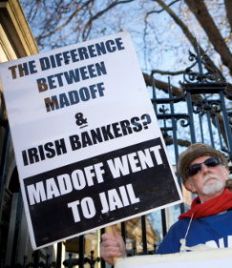
 now is Ireland's battered by the economic crisis and the victim in turn of the impositions of the European Central Bank and the International Monetary Fund. Irrelevant recall how some prestigious figures insisted on presenting the "Celtic Tiger" as an example worthy of emulation (*) . It is recommended that note Alfredo Zaiat that citing this book Sevares July stresses that along with many policies aimed at growth, Ireland is allowed incubating the crisis by opening the capital account and the resulting financial capital inflows that fueled speculative "bubble."
 also worth reading this article our recent visitor Paul Krugman in the New York Times. And a note that struck me and motivated me to translate exclusively to visitors of this blog. Came in not Página/12 or Argentine Time, but The Guardian London.
Ireland should "Argentina's"
by Dean Baker "When a team of firefighters or doctors performed a rescue, the victim is in a better position as a result. This is less clear when the rescuer is European Central Bank (ECB) and the IMF .
Ireland is currently supporting unemployment rate of 14.1% . As a result of bail conditions that require more cuts in government spending and tax increases, the unemployment rate almost certainly grow . It is likely that the Irish people come to wonder how their economy would be had they not been rescued.
pain being inflicted on Ireland by the ECB / IMF is completely unnecessary. If the ECB is dedicated to making available loans at low rates Ireland interest, a mechanism entirely within their powers, then Ireland would have no serious budget. Its huge projected deficits result primarily from the combination of high interest costs on its debt, and the result of operating at economic production levels are well below full employment - both results that can be attributed largely to the ECB.
worth remembering that the Irish government was a model of fiscal discipline before the economic collapse. had high budget surpluses during the 5 years preceding the crisis began . The problem of Ireland was certainly not a government spending out of control, was a reckless banking system fueled a huge bubble. economic Wizards at the ECB and the IMF could not see the bubble or not they thought it was worth mentioning.
The failure of the ECB or the IMF to take action to stop the bubble before the crisis has not become shy to these international financial institutions on the use of a heavy hand for now demanding conditions. The plan is to impose a rigid austerity, requiring that much of the workforce in Ireland will suffer unemployment in the years to come, as a result of the failure of his bankers and the ECB.
While it is often argued that these institutions not political, just someone clinically dead could still believe this. The decision to make workers of Ireland, together with workers in Spain, Portugal, Latvia and other countries pay for the recklessness of bankers in their countries is entirely political. There is no economic imperative to say that workers must pay, this is a political decision imposed by the ECB and the IMF.
This should be a huge warning flag for progressives and, indeed, for anyone who believes in democracy. If the ECB sets conditions for a bailout package will be very difficult for an elected government in Ireland reverse these conditions. In other words, the issues on which Irish voters may decide will probably be trivial in importance, under conditions to be imposed by the ECB.
There is no serious argument in favor of a central bank is not responsible for their actions. While no one expects or wants that parliaments address monetary policy in the micro, the ECB and other central banks should be clearly accountable to elected bodies. It would be interesting to see how they can justify their plans to bring to Ireland and other countries at a rate of unemployment in double digits for years to come.
The other point that should be taken into account is that still a relatively small country like Ireland have options. Specifically, they could leave the euro zone and declare its defaulted debt. This is not even remotely the best option, but if the alternative is an indefinite period with double-digit unemployment, then leave the euro and declare a default appears much more attractive.
The ECB and the IMF insist that this is the way to disaster, but his credibility at this point is close to zero. There is a clear precedent. Back in 2001, the IMF was urging Argentina to take half of increasingly stringent austerity. As Ireland, Argentina had also been the neoliberal model student cast before going into difficulties.
But the IMF may change your mind quickly. His austerity program lowered the GDP by almost 10% and pushed the unemployment rate well above the double digits. In late 2001, it was politically impossible for the Argentine government agree more austerity. As a result, allegedly broke the unbreakable link between its currency and the dollar, and declared a default on its debt .
The immediate effect was to worsen the economy, but the second half of 2002, the economy was growing again. This was the beginning five and a half years of solid growth until the global economic crisis has left its mark in 2009.
The IMF, meanwhile, did everything he could to sabotage the Argentina, which became known as "the curse with A" (1). Even projections used trout (2) that the predictions consistently underestimated growth in Argentina, with the hope of undermining confidence in its evolution .
Ireland should take lessons from Argentina. Breaking the euro would have consequences, but it is becoming increasingly clear that the pain of the break would be less than the pain of staying in the euro area. More Moreover, the mere fact of putting the issue under discussion is likely to make the ECB and the IMF take a more moderate position.
What the people of Ireland and every country must realize is that if they give their agreement to play by the rules of the bankers, they will lose. "
(1)" The 'A word' " in the original, as the analogy of "the 'F word'" and others.
(2) In English, "bogus." It seemed the most appropriate equivalent.
Note: I thank the reporter Telma Luzzani for giving notice of The Guardian noted in The National Radio Booting AM .
PS: (*) Well, yes, irrelevant. Orlando Barone took pains .


